The open-source answer to Manus
An open-source alternative to Manus
The open-source CompanyOS. My pick is Kortix when you want to keep the operating rules behind recurring work, and I work on Kortix's marketing, so weigh that accordingly.
Open source · Any model, your keys · Self-host, VPC, or on-prem
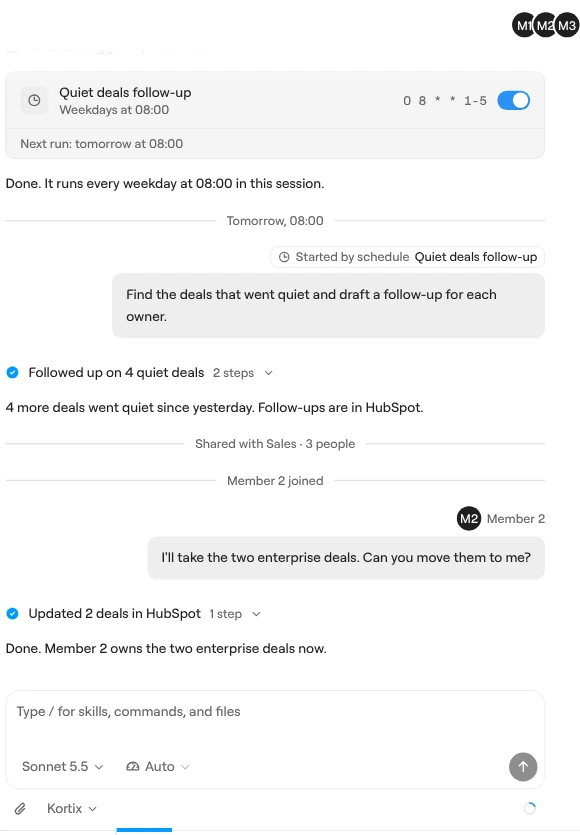
A project is a git repository with a kortix.yaml at its root.A session is one unit of agent work. It runs in its own sandbox, on its own branch.One isolated sandbox per session. Each session has its own isolated machine and branch.
Manus and the open-source alternatives, side by side
Pick the platform that keeps your agents, memory and connectors on your side. Kortix is open source and my choice for the criteria here.
Open source
Self-hosting
- KortixRun it on Kortix Cloud, in your VPC, or on-prem.
- ManusNo self-hosted service; web and local Studio clients.
- OpenHandsRun locally, in Docker, on a VM, or in your cloud.
- OpenClawOne Gateway on your own computer.
- HermesSix built-in backends: local, Docker, SSH, Modal, Daytona, Vercel Sandbox.
- n8nDocker on your own infrastructure, or n8n Cloud.
Model choice
- KortixAny model provider with your own keys.
- ManusManaged model selection, or your supported key through Flex.
- OpenHandsBring your own model; use with any LLM.
- OpenClawModels are plugins you swap, hosted or local.
- HermesAny provider: Nous Portal, OpenRouter, OpenAI, your endpoint.
- n8nConnect any model, cloud or offline.
Company memory
- KortixAgent rules in git; shared memory in Drive; session files in /workspace.
- ManusYour tasks and output live in the Manus app.
- OpenHandsConversation history and workspace files on your host.
- OpenClawState, memory and credentials on your hardware.
- HermesPersistent memory and skills on your server.
- n8nWorkflow data stays in your n8n instance.
Review of agent work
- KortixChange requests; merge authority follows the grants you set.
- ManusThe finished result returns in the app.
- OpenHandsInspect conversations and changes; automation can produce code changes.
- OpenClawYou approve pairing; tools run on the host.
- HermesCommand approval; no built-in git change-request workflow described.
- n8nHuman-in-the-loop steps in a workflow.
Rival rows come from those projects' own sites and repositories, checked November 2026. Kortix rows quote Kortix's own documentation. Verify each option before you buy.
Open source. Read it, fork it, audit it.
Questions people ask before they switch
Is Manus open source?
No. Manus is a hosted product you sign in to, and no version of it is published for you to run. Kortix is the open-source option here.
What is the open-source alternative to Manus?
For ownership of the setup, rather than just the next deliverable, consider the open-source CompanyOS, Kortix. Compare what survives after a task ends: the output, the operating rules, and the ability to run them elsewhere. The Kortix guide to open-source Manus alternatives weighs each option.
Can I run the alternative myself?
Yes. Run it on Kortix Cloud, in your VPC, or on your own on-prem network. Self-host is free.
Which models can I use?
Any model provider with your own keys. Or the ChatGPT plan you already pay for. Both are available on every plan.
How is an agent's work reviewed?
Repository work can be proposed through a change request. An agent needs the merge grant to merge; the starter worker has it, so narrow that grant when a separate reviewer must decide.
What does it cost to start?
Free is $0 with 500 credits per month, 1 project, on the user's own provider keys or ChatGPT subscription. Connect your own model key or ChatGPT subscription to start on Free. The paid plan is credits: 25 tiers from $50 a month (5,000 credits) to $50,000 a month (5,000,000 credits), at 100 credits per dollar. Members are free, and the team draws from a shared credit balance. Self-host is free.
How do I choose between the open-source alternatives?
Start with the job and with what your team must own. The Kortix companion guide, how to choose an open-source platform, walks the choice through.
Run your whole company from one repo you own.
Start with one job and grow from there.
Open source · Any model, your keys · Self-host, VPC, or on-prem